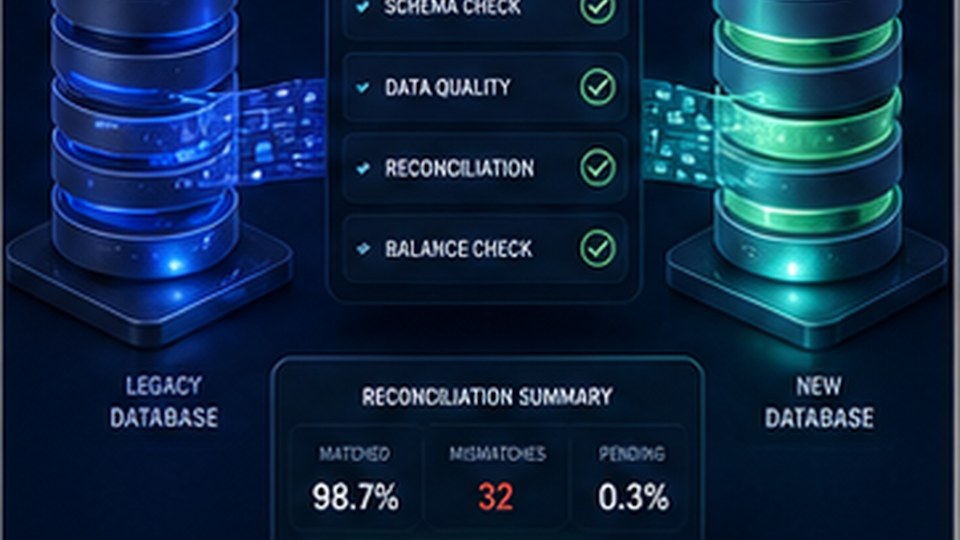
Why this decision matters
Moving important operational data into newly built custom software can look like a technical problem, but the important decisions usually sit inside the workflow. Teams need to understand who performs the work, what information is trusted, where exceptions appear and what a successful result means before choosing an implementation approach.
Treat migration rules as reviewable business decisions and prove them repeatedly with representative source data. This keeps the conversation connected to business value and prevents a broad technology initiative from becoming a collection of disconnected experiments.
Turn the operating context into a design
A useful discovery process makes four areas concrete: source profiling, mapping rules, migration rehearsals, business reconciliation. Each area exposes dependencies that are easy to miss when a project is described only as a list of screens or integrations.
The team can then organise the work into a reviewable journey. Important permissions, data boundaries, failure states and responsibilities become part of the product design instead of late-stage technical corrections.
Keep delivery small enough to learn
A focused first release should prove one complete path from input to outcome. It does not need to solve every related problem. It does need enough real context to show whether the workflow is understandable, the information is available and the operating team can support it.
Review points should be planned around evidence: representative scenarios, usability observations, integration responses and operational exceptions. This gives stakeholders something more useful than a percentage-complete report.
Define what happens after release
Release is the beginning of a supported operating cycle. Ownership for monitoring, feedback, access changes, content or data quality and future improvements should be clear before the product reaches users.
a controlled cutover with trusted records and explainable exceptions is a stronger indicator of progress than output volume. Profile the source data for missing values, duplicates, invalid formats and conflicting identifiers. From there, the next release can be chosen using observed needs rather than assumptions.